


WHY PHYSICAL AI MATTERS AND WHY NOW
Robotics is moving beyond deterministic automation. Traditional systems excel in structured environments but are typically pre-programmed for specific tasks and struggle as variability increases. Physical AI adds layers of learning, perception and reasoning, enabling robots to understand context, adapt to changing environments and handle a broader range of real-world edge cases.
This report examines the evolution of Physical AI, the underlying technology stack and the segments where we believe value will accrue. Our focus is primarily on the embodied layer - robotics and the infrastructure that enables it - where intelligence ultimately translates into physical action. While autonomous systems and industrial intelligence extend across and beyond robotics, we concentrate on the embodied stack. We also explore where India stands in this sector and what opportunities exist in the country.
DEFINING PHYSICAL AI AND ITS BREAK FROM TRADITIONAL ROBOTICS
Distinguishing Physical AI from traditional robotics is critical: while the latter requires human intervention for every unforeseen edge case, Physical AI leverages a reasoning layer to handle real-world variability.
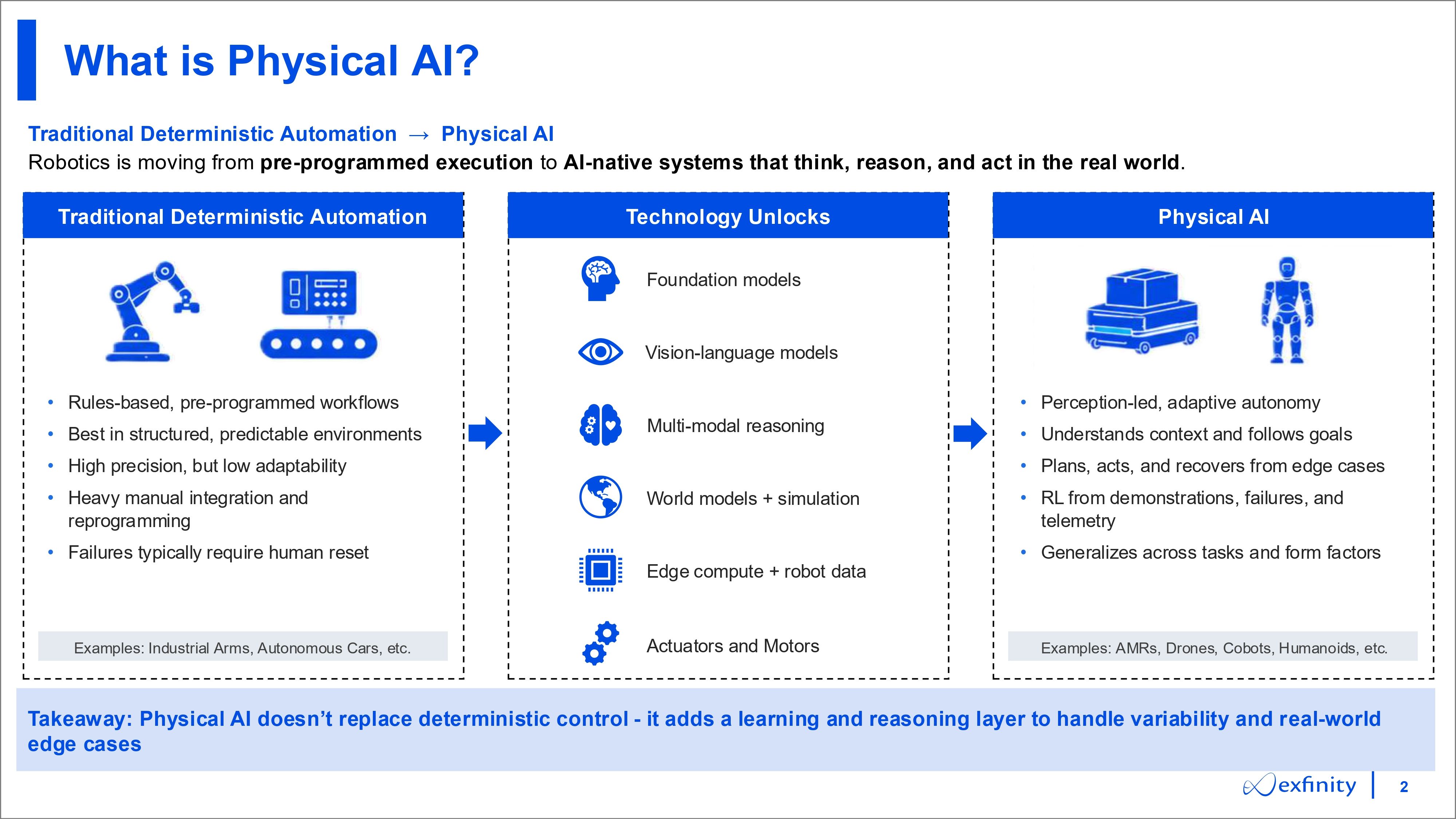
The Paradigm Shift defines this transition as a move toward perception-led, adaptive autonomy. Traditional systems are high-precision but low-adaptable. Physical AI, conversely, understands context, follows high-level goals, and possesses the inherent ability to recover from failures without a manual reset.
The Technology Unlocks for scaling beyond a single function on the factory floors lies in three core technical breakthroughs:
- Vision-Language Models (VLM): Enabling robots to reason about spatial context using natural language.
- Multi-modal Reasoning: Integrating disparate data streams into a single decision-making framework.
- World Models: These serve as the strategic shortcut for physics-based reasoning, allowing robots to observe and predict physical interactions without requiring decades of legacy datasets.
WHERE ROBOTIC CAPABILITY STILL FALLS SHORT
The maturity framework evaluates where current robotic functions sit relative to human capability, highlighting the remaining bottlenecks for generalized autonomy.
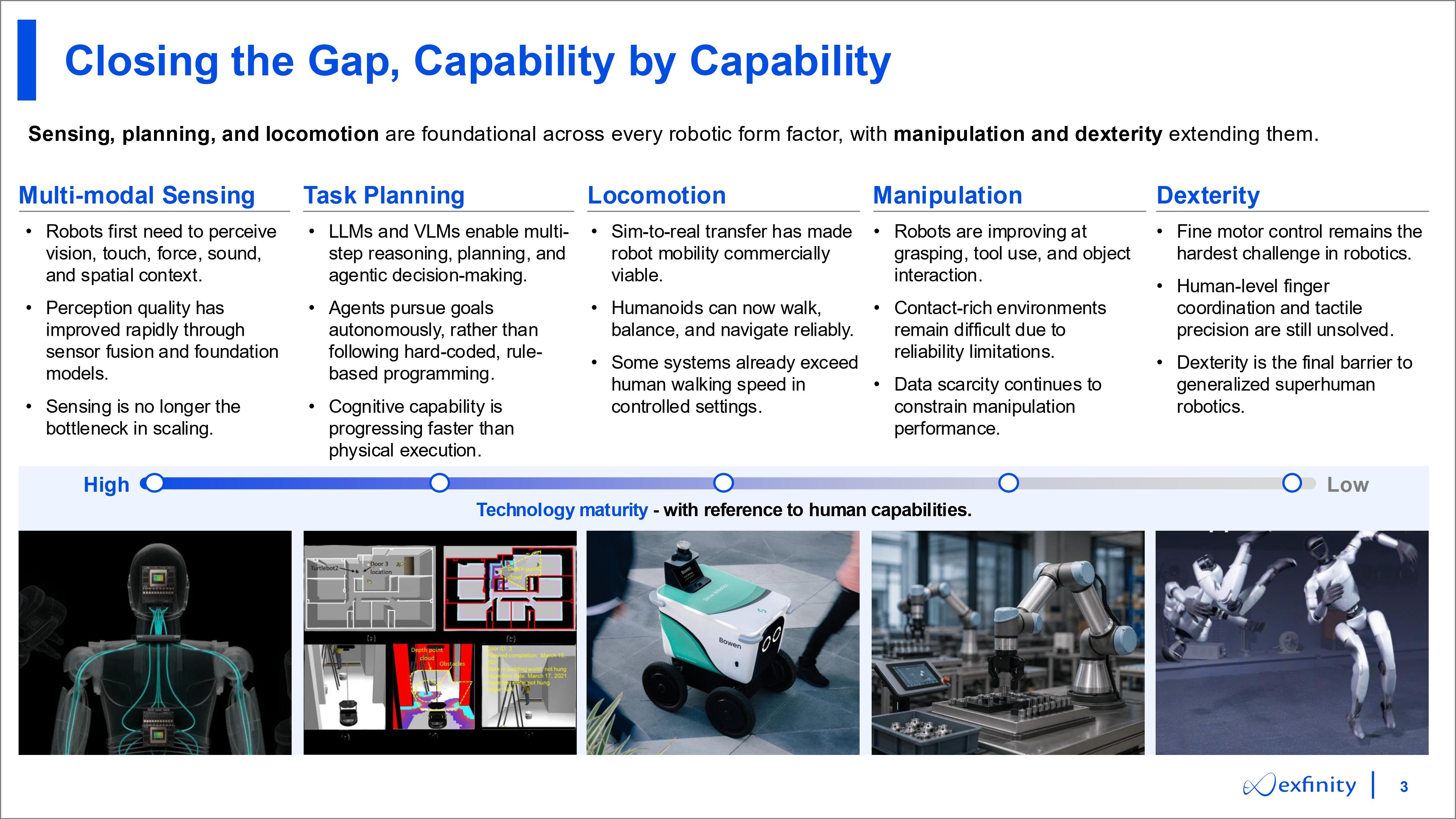
The Maturity Spectrum
- Multi-modal Sensing (High Maturity): Sensing vision, touch, and sound is no longer the scaling bottleneck.
- Task Planning & Locomotion (Medium Maturity): LLMs and VLMs have accelerated agentic decision-making, while sim-to-real transfer has made robot mobility commercially viable.
- Manipulation & Dexterity (Low Maturity): Fine motor control and tactile precision remain the "hardest challenges."
This Reliability Gap is where Vertical Robots can achieve reliability in narrow, high-value domains - over general-purpose humanoids in the near term.
WE MUST UNDERSTAND THE SIX-LAYER PHYSICAL AI STACK TO EXPAND CAPABILITIES
Anyone building a Physical AI robot today must navigate a bottom-up stack. This six-layer architecture rigorously maps the technology required across the embodiment layer.
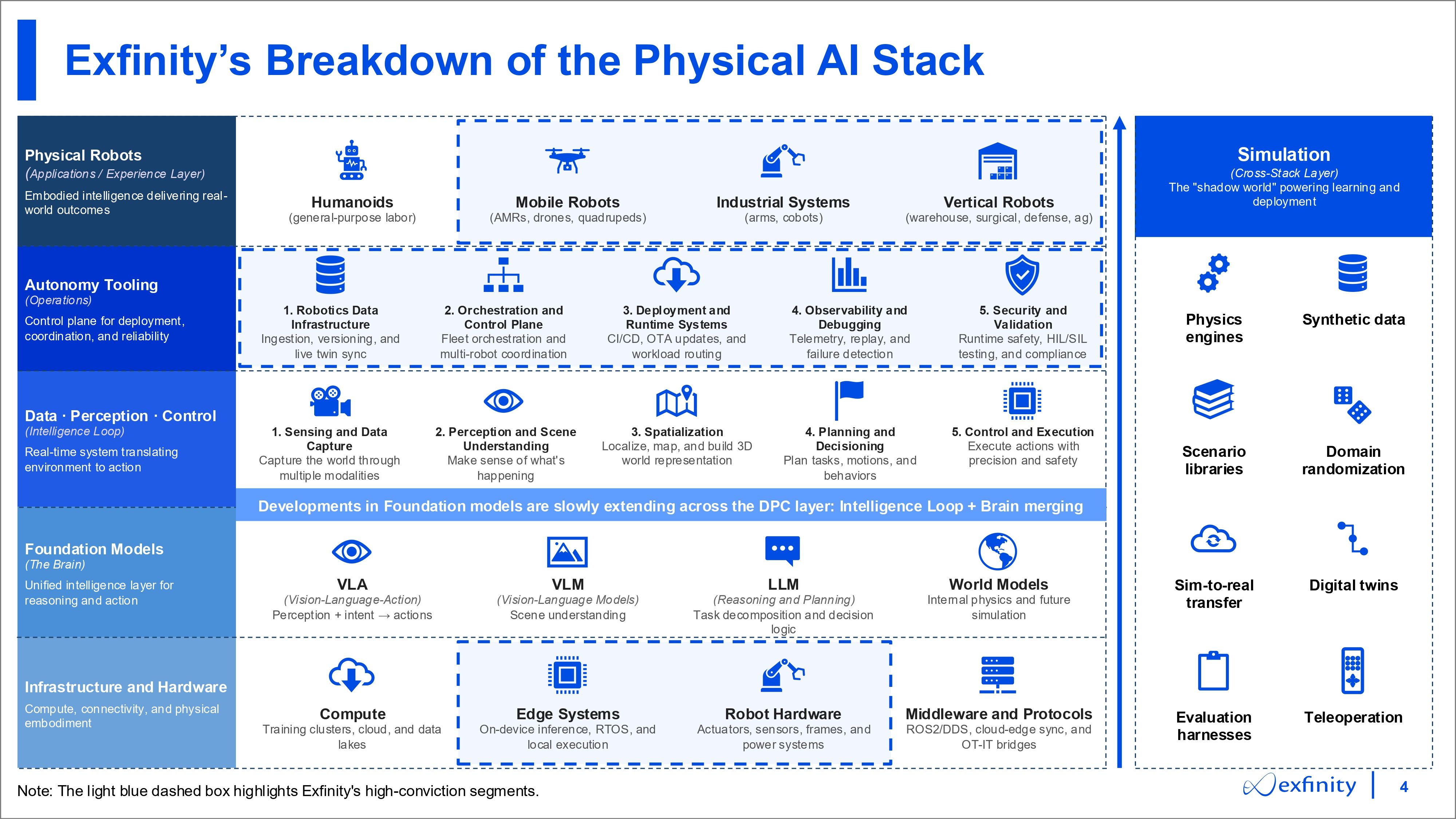
- Infrastructure & Hardware: Beyond raw compute, this includes Edge Systems (on-device inference) and Middleware/Protocols (ROS2/DDS) that provide the connective tissue for robot-to-cloud synchronization.
- Foundation Models (The Brain): The intelligence layer now incorporates Vision-Language-Action (VLA) models, which translate perception directly into intent-based actions.
- Data-Perception-Control: The real-time intelligence loop for mapping, localization, and precision execution.
- Autonomy Tooling: The operations plane for orchestration, observability, and security.
- Physical Robots: The experience layer, ranging from AMRs to specialized industrial systems.
- Simulation (Vertical): The cross-stack “shadow world” for physics simulation, synthetic data, digital twins, sim-to-real, and validation.
WHY INDIA IS READY TO BUILD THE STACK
India is strategically positioned to be a key global player from inception, with the right combination of global R&D presence, proven Physical AI companies, and exceptional STEM talent density.
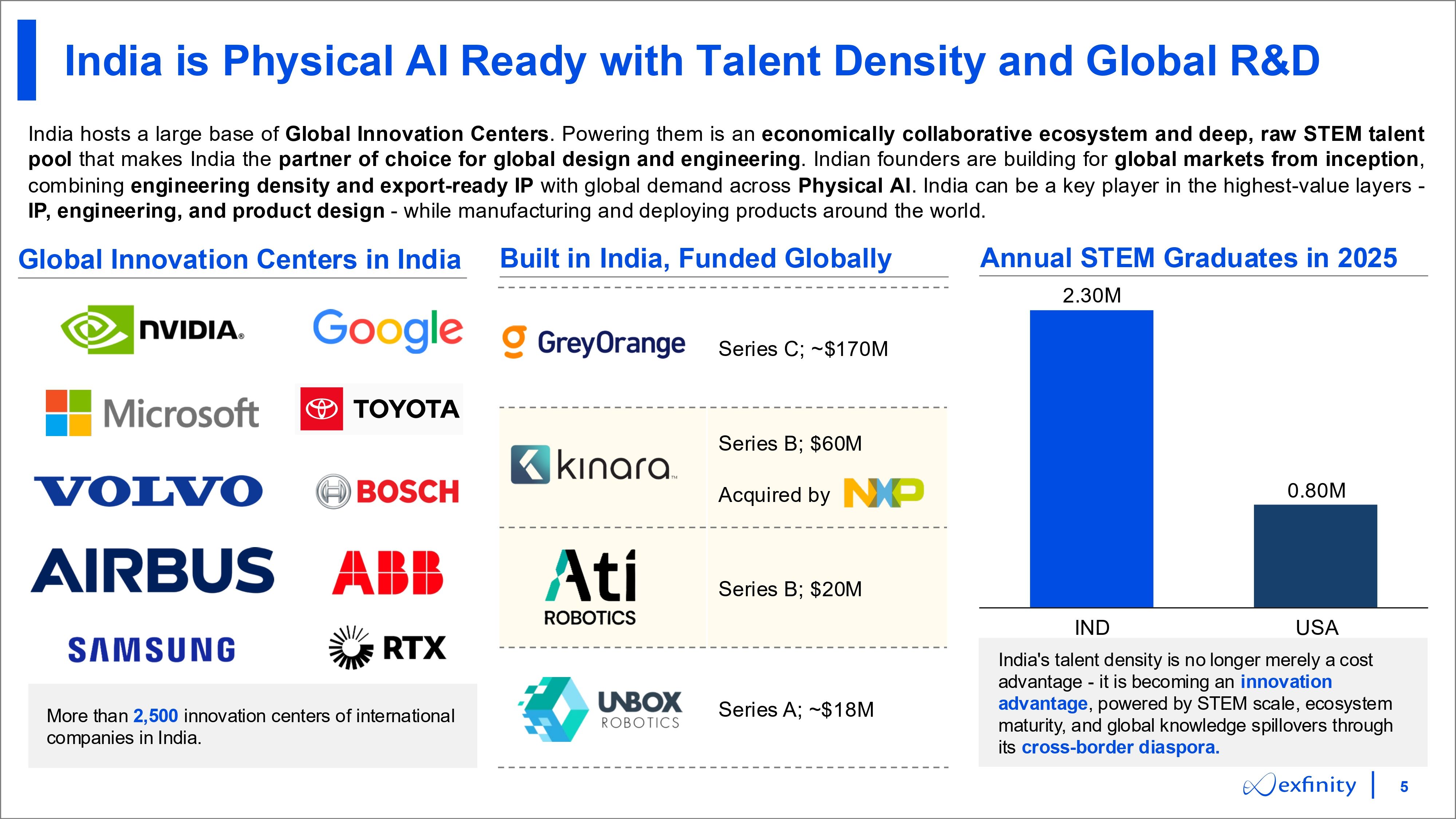
India hosts over 2,500 Global Innovation Centers from leaders like NVIDIA, Google, and Bosch, creating a deep ecosystem for global R&D, engineering, and product design.
India is already producing globally funded Physical AI companies. GreyOrange, Kinara, Ati Robotics, and Unbox demonstrate India’s ability to build export-ready IP across high-value layers of the stack.
The Talent Advantage India’s STEM engine produces a high-beta opportunity that the US can no longer match in raw volume. (2.3M STEM Graduates in India vs. 0.8M in the USA in 2025)
WE MAP THE INDIAN COMPANIES ALREADY IN PLAY
The Indian ecosystem is field-testing the Physical AI thesis - but mostly at the top of the stack.
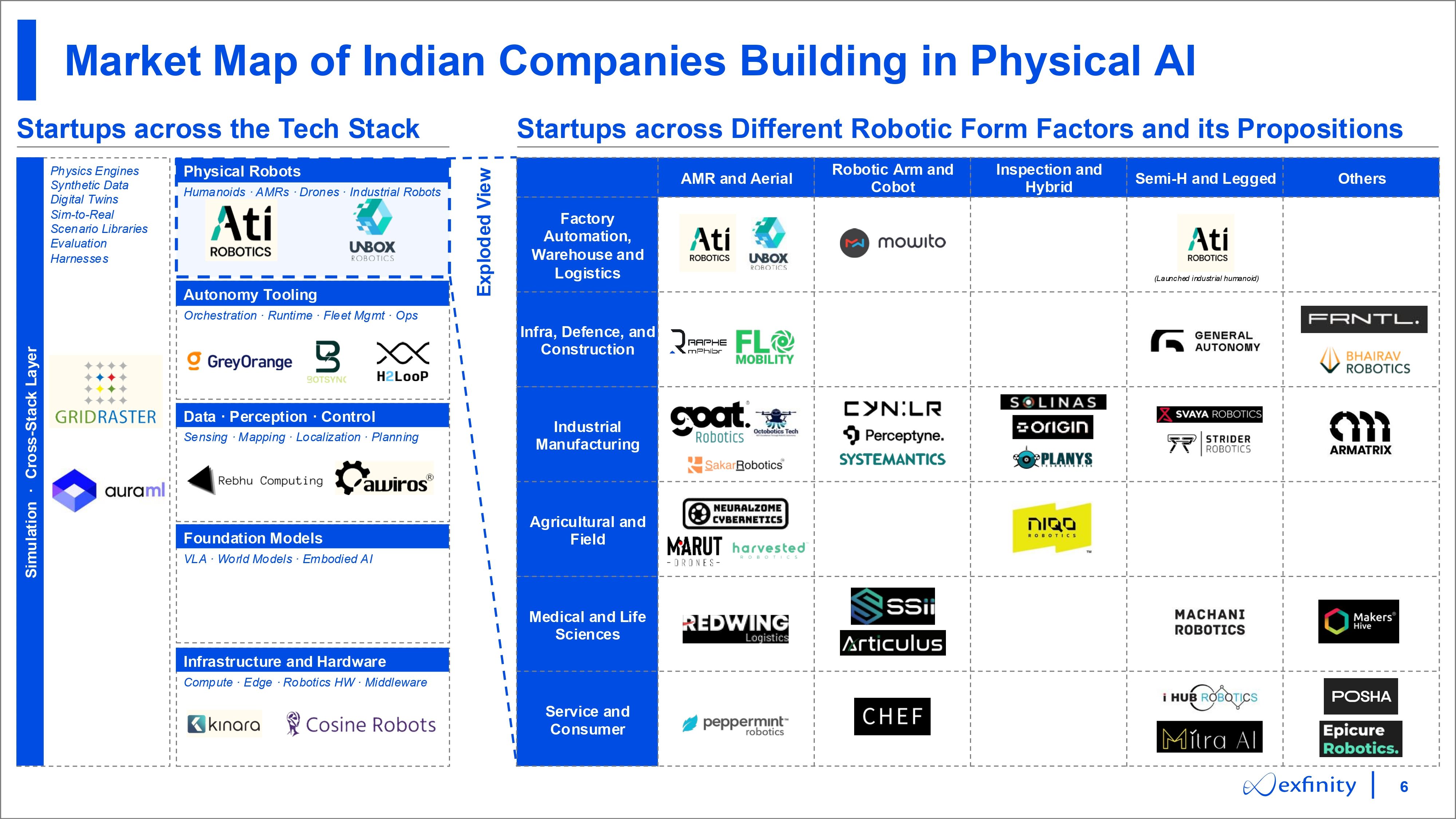
Our market map reveals meaningful activity in applications and form factors:
- Form Factors: Significant innovation is occurring in AMR & Aerial (Unbox Robotics, Raphe Mphibr), Robotic Arms & Cobots (CynLr, Systemantics), and Legged Robots (Ati Robotics).
- Vertical Specialization: Startups are solving high-stakes problems in Medical & Life Sciences (Articulus, SSii) and Agricultural (Marut Drones), where specialized workflows offer a faster path to commercialization.
- Infrastructure & Tooling: Companies like Kinara (Edge AI) and GreyOrange (Orchestration) provide the "operating system" for fleets.
The gap is at the base - foundation models and infrastructure purpose-built for Physical AI remain limited.
BASED ON THE ABOVE, EXFINITY'S THREE AREAS OF CONVICTION ARE AS FOLLOWS
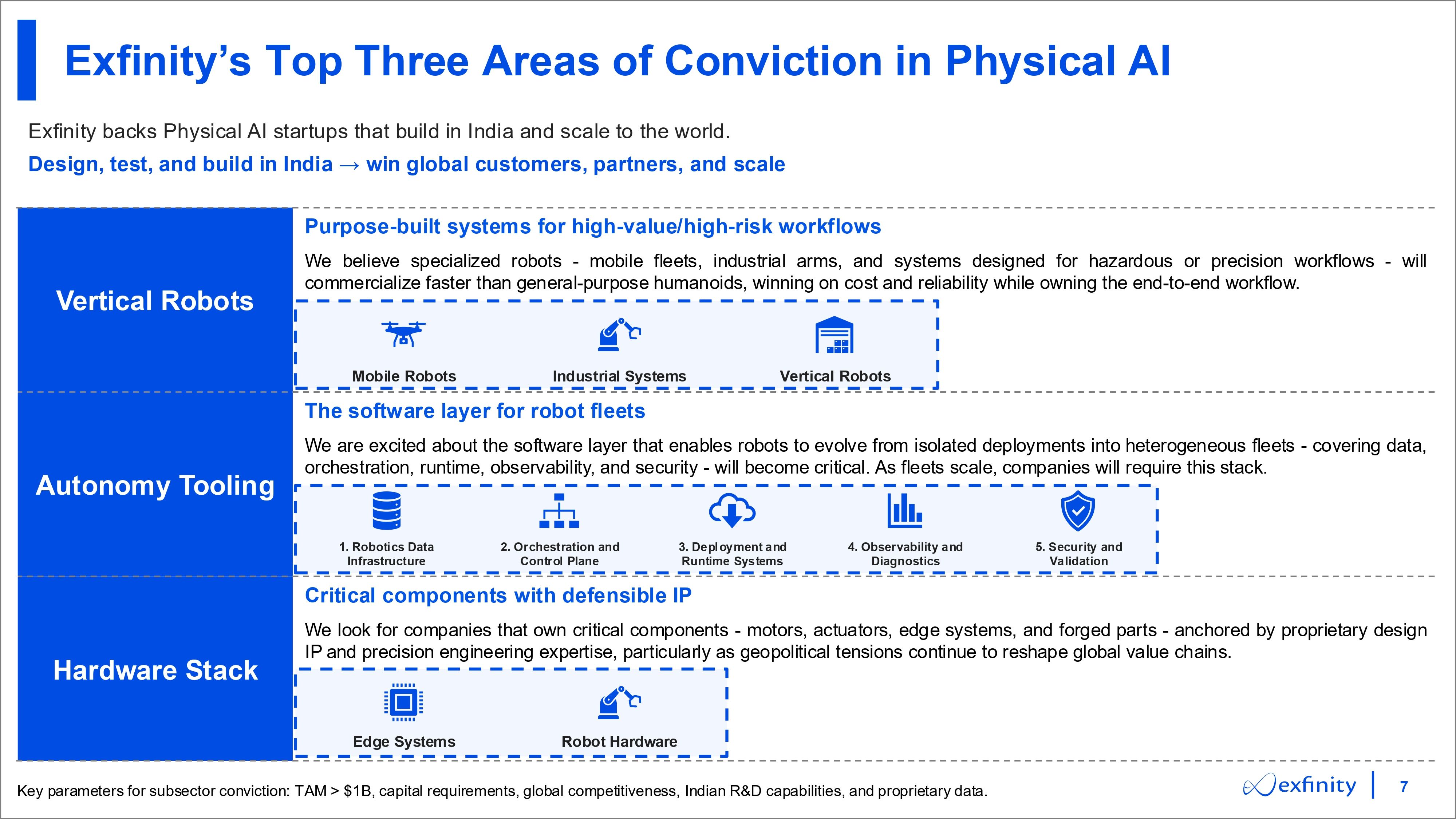
I. Vertical Robots
For high-value/high-risk workflows, specialized systems prioritize reliability in high-stakes domains - manufacturing, surgical suites, Industrial plants long before general-purpose robots can successfully navigate the real life environments.
II. Autonomy Tooling
As deployments move to large heterogeneous fleets, the software layer to manage them-data infrastructure, orchestration, and security-becomes the critical control plane.
III. Hardware Stack
Proprietary design IP in critical components: motors, actuators, and Edge Systems. Critical components offer defensibility where proprietary engineering directly drives performance and reliability.
THE PHYSICAL AI INFLECTION IS HERE AND WE ARE BACKING THE BUILDERS OF THIS SPACE
The transition to Physical AI is a current market reality.
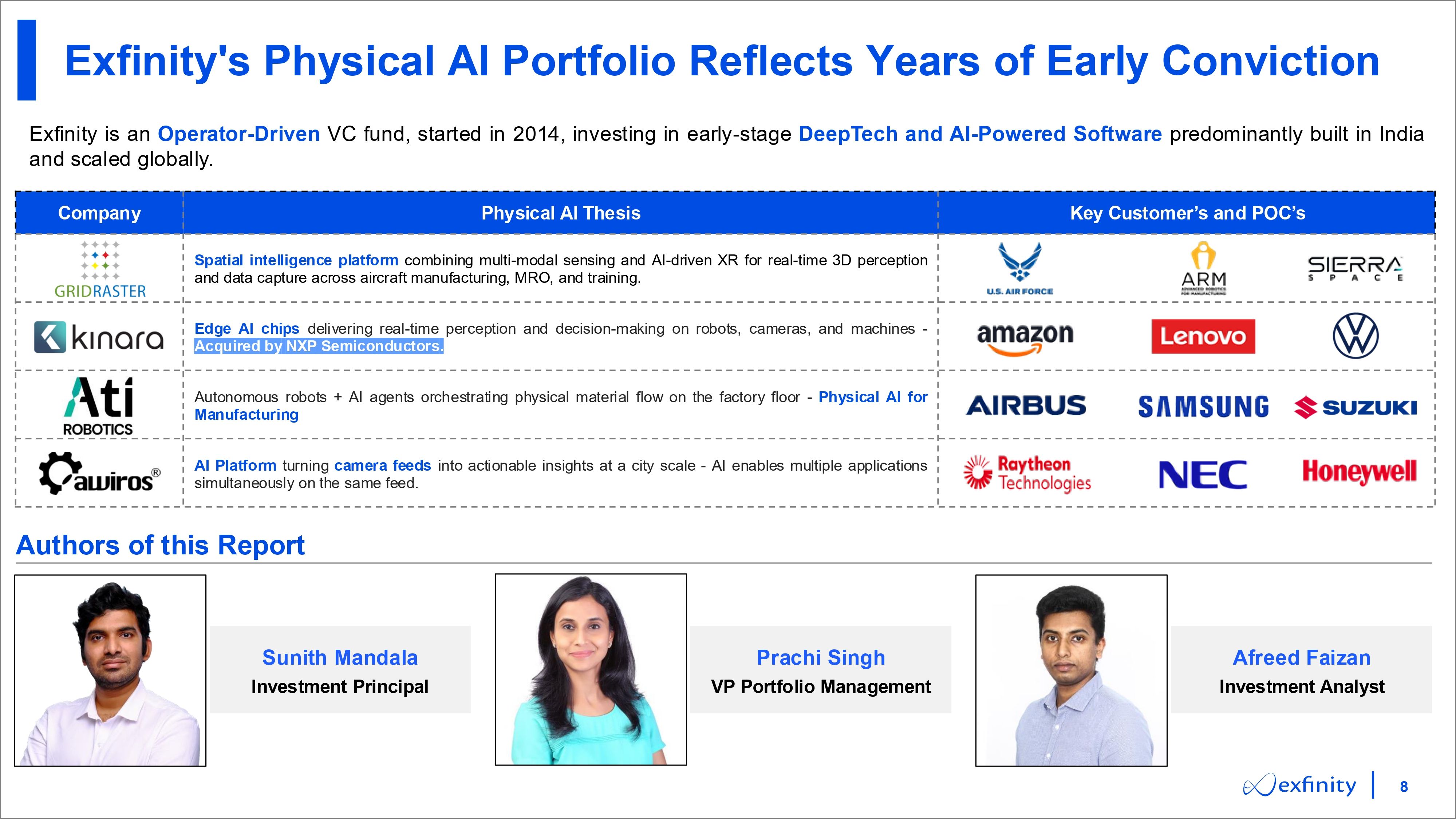
Exfinity Venture Partners is the partner of choice for architects of the physical future. We are backing the founders building the next generation of Physical AI.
If you are innovating in Robotics, Autonomous Systems, Industrial Intelligence, or Infrastructure, we would love to hear from you. Please reach out to us at info@exfinityventures.com. Let’s talk.